




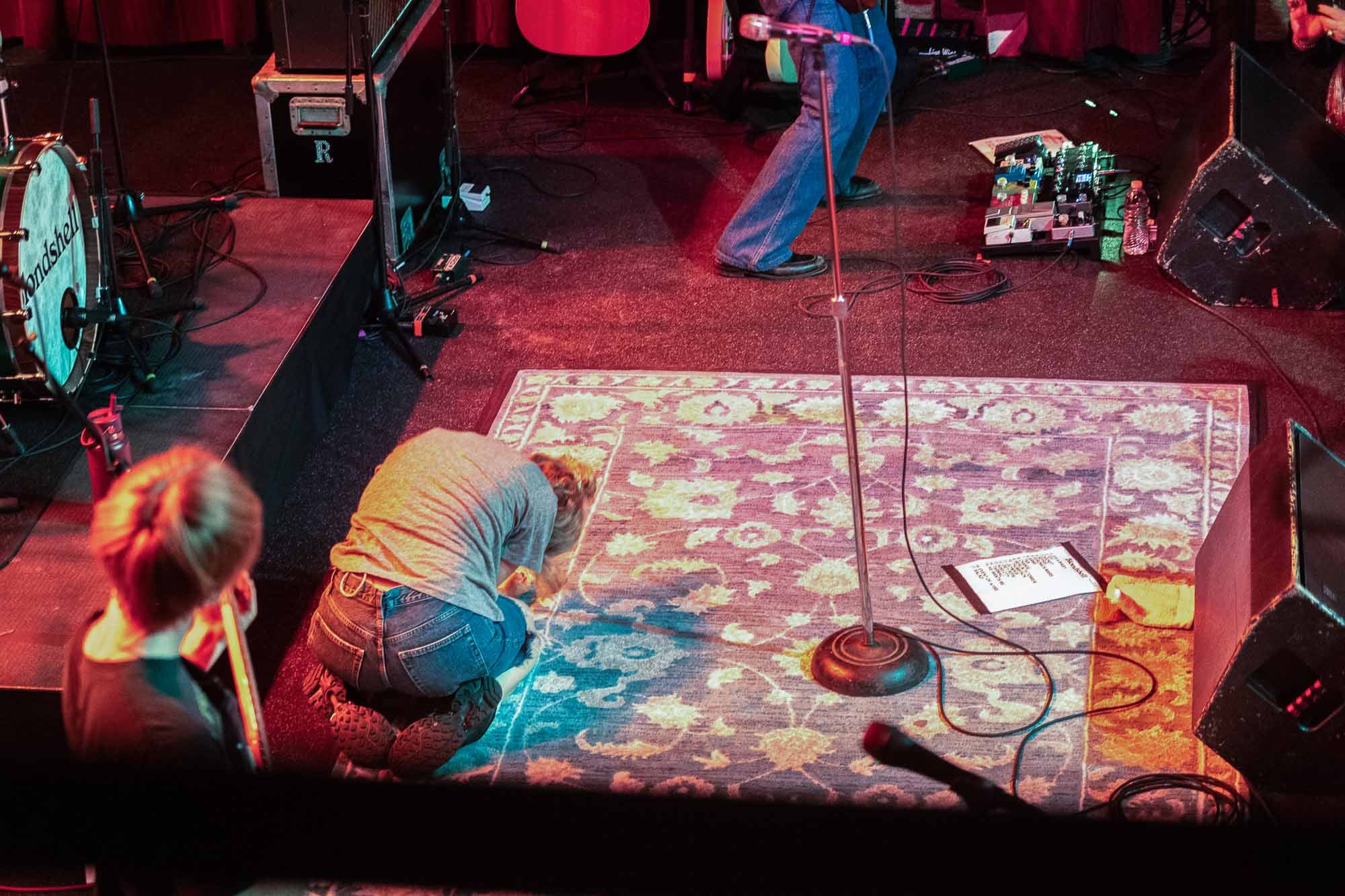
You scan your ticket, head into the club for the show you’ve been waiting months to see, and there it is. I’m not talking about the amps or the roadies. I mean the worn oriental rug on the stage, with amp cords snaking across the fringe. It’s such a familiar sight that most of us never wonder why it’s there. It turns out the stage rug has a real history, a real job to do, and a surprisingly deep connection to rock and roll.
Where it came from
I couldn’t pin it to one “invention” moment, but the roots go back way before electric guitars and amplifiers. Medieval fairground performers carried a carpet under their arm and rolled it out wherever they stopped, which basically made their show have a stage that was portable. Jazz players were reportedly working on rugs by the 1920s.
For rock, the trail leads to the late ’60s and early ’70s. One of the earliest sightings people point to is Crosby, Stills, Nash and Young at the Fillmore West in San Francisco in 1970. Promoter Bill Graham apparently remembered the band bickering over the rug’s placement well enough to write about it in his memoir. “Bill Graham: My Life Inside Rock and Out.” After that, rugs were everywhere: the Grateful Dead, Led Zeppelin, Pink Floyd, Eric Clapton, Pearl Jam, Nirvana. The timing isn’t a coincidence. Rock was soaking up Indian and Middle Eastern sounds back then, and the rug became a kind of visual shorthand for it.

What it actually does
Ask a working musician, and you’ll get practical answers first:
- Grip. Stages get slick with sweat and spilled drinks. A rug gives you something to stand on that is a little more comfy than a hard surface.
- Staying put. Kick pedals and hi-hat stands love to creep across a bare floor due to vibration. A rug, ideally with a rubber pad underneath, holds the kit in place.
- Hiding the clutter. Cables, pedals, and mic stands look like a mess on bare wood and look intentional on a rug.
- Sound, maybe. This one’s debated. Some drummers swear a heavy rug tames vibration and harsh reflections. Others say the effect is minor and it’s really about grip and looks. It likely really depends on the room, the floor, and the rug.
Then there’s the lore. Some fans say the Grateful Dead’s rugs helped Jerry Garcia find his spot on stage, though that one’s more rumor than record. Greg Lake of ELP claimed his rug kept him from getting electrocuted on stage back in 1974. True or not, those stories are part of the appeal.
Trend or function?
Both, and they feed each other. The rug has stuck around because it’s useful and because it looks like rock and roll. A new band unrolling a $150 rug from a home goods store is plugging into the same tradition, whether they mean to or not. Some bands even print their logo on theirs and treat it as part of the show.
Closer to home
You don’t have to go to a stadium to see this. At The Palace Theater in St. Paul or the Fine Line in Minneapolis, you’ll often find a rug on the stage, whether the band brought it or the crew rolled it out. It’s how working bands in rooms like these set up every night: a spot to stand, a place for the pedalboard, and a floor that feels like it belongs to the band.
The downside, and the alternatives
Anyone who’s gigged on the same rug for a few months knows the problem. Beer, sweat, and bar-floor grime add up to a smell that no amount of Febreze or Lysol fixes. It’s also one more bulky thing to haul into the van or bus.
If you want the function without the funk (the smell kind, not the music genre), there are options:
- Drum mats: thin, grippy, and made to anchor pedals.
- Foam or rubber stage tiles: traction and a little vibration control.
- Gaff tape: for cable management alone, though it ain’t cheap.
- A drum riser with isolation pads: better for vibration than a rug ever was.
None of them have the same look, which is probably why the oriental rug has outlasted them all. Used ones can be found cheap, it does a few jobs at once, and it looks the part. So next time you spot amps sitting on a faded, fringed carpet, know that you’re looking at decades of tradition, a genuinely useful piece of gear, and a small nod to every band that rolled one out before.


