



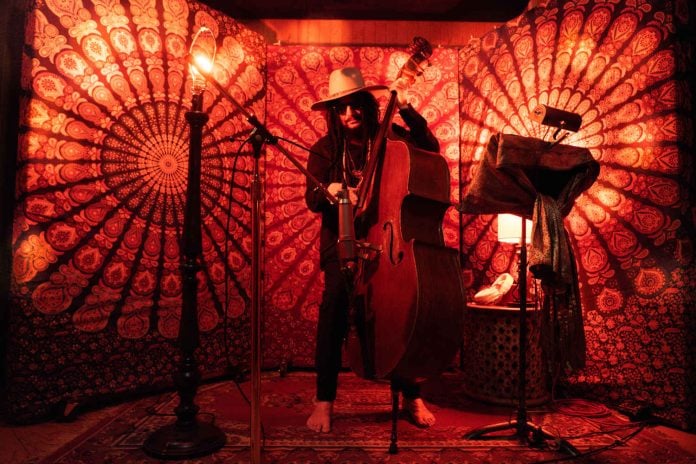
The last time we spoke to legendary producer/bassist/executive Don Was, He was just about to play his first shows with his talented then-new band The Pan-Detroit Ensemble. At the time, he expressed tremendous excitement for the project, which sought to celebrate Detroit’s storied musical legacy the with some of the Motor City’s Best musicians. At the time, it seemed like a fittingly ambitious move for the always on-the-move Was, who has spent much of his storied career as an A-list producer, High-level executive, and occasional sideman. As Daunting as starting any new project may seem, let alone one as ambitious as an improvising, versatile big band, Was expressed tremendous excitement for the promising project.
Flash forward to today, and the Pan-Detroit ensemble is in a much different place. They’ve been touring hard since those early shows, and recorded an album (2025’s fantastic Groove In the Face Of Adversity) along the way. As witnesses to those shows can attest (including those lucky enough to catch their set at this year’s Outlaw Festival), the band has evolved into a true powerhouse, with exceptional talent in each role, and the kind of chemistry that can only be forged with continuity. As Was sees it, the band has come a long way in a few years. On Sunday evening, Don Was and The Pan-Detroit Ensemble return to the Dakota for two highly anticipated shows. The shows offer fans a chance to not only catch a versatile big band operating at an exceptionally high level, but also affords the opportunity to see them do something truly unique-an interpretation of the Grateful Dead’s ambitious 1975 album Blues For Allah. The record, while not the Dead’s most celebrated release in a traditional sense, is one of their most ambitious and adventurous. It’s also one of the Dead’s jazziest releases, which meshes well with Was and the Pan-Detroit ensemble’s style(s).
To hear Was tell it, arranging and playing the album, especially its most complex songs, provided a welcome challenge for the group. In our conversation, Don shares his thoughts on playing the album, as well as takeaways from working with the Grateful Dead’s Bob Weir, who he spent many years playing with in their “Wolf Bros” Project before Weir’s passing in January. As always, Don is thoughtful, candid and witty throughout.
Below is an Interview with Don Was. The Following has been edited.
Music In Minnesota: Last time we spoke, you were about to play some of your first shows with the Pan-Detroit Ensemble. At this point, you guys have been on the road for a couple of years and you’ve released an album. How, from your vantage point, has the project evolved over the last couple of years?
Don Was: Well, we’re better (laughs). One of the things I learned from Bob Weir is that it takes years to form the foundation of a band, to develop the sound, and to develop the trust among the musicians so that one can go out a limb and know that there are eight other people there to catch them. We actually are a better band. The first gig we ever played was at the Dakota. I think the musical conversations have gotten much more interesting, and I like the songs we’re playing better than what we played last time. It’s just evolving, that’s the fun part of it. The cool thing is that it’s still fresh. We haven’t become set in our ways-there’s no need to, except laziness. We Improvise on top of a very specific structure to the songs, so we play them differently every night. The drummer will play a different beat, so I’ve got to change my bass part. If I’m playing the same thing, it’s almost for certain I’m going to play something wrong, because everyone else has moved on. You do it differently every night. Whoever is feeling strong that night steps forward, and sets a certain direction for how a certain section of a song feels, and everyone follows suit. It’s a lively interaction. To me that’s the main thing that’s evolved.
MIM: You guys are such a big ensemble. Is there a difference in how that conversation evolves in a larger ensemble versus in a smaller group?
DW: I would think so. Really for the reasons we just talked about, whoever is feeling confident and in touch with an inspired energy field that night (laughs) will take the lead. The chances are there with a larger band-you’re never gonna have a moment where someone doesn’t feel strong. The odds are in your favor (laughs). And if the trumpet player is feeling strong, taking everybody on a journey, you’ll play a certain way. It’ll be different than if the guitar player is feeling strong that night. It heightens the possibilities for adventure and non-repetition, I think.
MIM: You have a lot of shows under your belt with this project. You’ve played a ton of different venues, settings, and setups. I saw you guys at the outlaw festival recently, does the venue or the setup factor into that conversation. What do you like about playing in a club?
DW: There’s physical immediacy in a club. People are right there. What you’re after as a musician, I think, is interaction with the audience- an energy exchange really. Grateful Dead audiences are super tuned in and they do react to what you’re playing. You can feel that reaction come to the stage almost immediately. It impacts the choices of where you’re gonna go next. The audience becomes part of the band really. So, there’s something about having everyone close to you where you can see all of the faces. In an enclosed space as opposed to an amphitheater, you can feel heat-literally! There are a bunch of bodies in a room raising the temperature of a place. It’s quite graphic. I love the amphitheaters too, it’s not daunting. Frank Sinatra once advised that a singer pick a beautiful woman from the audience and play the show to her, so it feels personal to everybody. At first, I thought maybe it wasn’t true. But when we were up here with Willie, we were on early. Towards the front there were empty seats where people hadn’t gotten there yet. We were playing six hours before Willie played. It didn’t matter at all, because I could look back to the lawn and see three people dancing to the music and feeling it. You play to them, so the distance isn’t always a deterrent to a transcendental experience.
MIM: I want to circle back to the Dead. On this run, you guys are playing from Blues For Allah. It’s such a vast catalog, why did you choose to focus on that particular record?
DW: The actual initial reason was kind of mundane really. It was the 50th anniversary of the album, and we got booked to play kind of a Grateful Dead festival in Georgia called The Golden Road Festival. The promoter said “Why don’t you do Blues For Allah?” And it just seemed like a cool challenge at the time. The beauty of that album is I think you can tell that they’re stretching, that they’re trying to reach another level. You can feel the quest for musical freedom and the fearlessness and the adventurousness in that record. Plus it contains some great songs-I think “Music Never Stopped” is probably Bobby’s greatest song. It’s fun to play those songs. So it happened in a very non-romantic way, but here’s the thing: You don’t want to play karaoke Blues For Allah, or karaoke anything for people. That’s actually the greatest violation of the spirit behind that music. So we had to find a way to play these songs that would allow us to be honest in the way we’re playing, and be ourselves. Some songs it was fine, but others required some consideration. The best example is “King Solomon’s Marbles,” which has a crazy time signature. Honestly, when I listened to that album years ago I always kind of skipped that track, and thought it was a jam that happened once. Once we set our minds to play the album in it’s entirety in sequence, I had to consider that song. If you really get into it, it’s got a structure that’s as specific as “Ripple” really. But it’s got that crazy feel to it. We could play it, but we couldn’t play it from the heart. So I happened to notice that it began with Jerry playing the riff to “Inner City Blues” or some derivation of it. I thought, well we know how to do that (laughs). So we put it in 4/4, took the feel of “Inner City Blues” and then played the song to it. That way, we can sink our teeth into it, and take it for an honest ride every night. Those kind of challenges make it fun. I warn the audience every night that we Detroiticized the album a little bit so that we could play it from the heart. Nobody seems to object.
MIM: One of the things I like about those fans and that scene, as you alluded to before, is that it’s a scene where the fans have high standards, but are very open minded. Whether it’s The Pan-Detroit Ensemble, or Wolf Bros, Dave McMurray, or John Mayer, if you play it well and play it honestly, they’ll appreciate it and come around to it.
DW: You’re 100% right. When I started playing with Bobby in 2018, we did it without a lot of rehearsal. He was fearless about getting up in front of 2,500 people and not knowing what we were going to do. To call it admirable would be an understatement. It’s just a wonderful way to approach music, with fearlessness and lack of self-consciousness. The first couple shows I thought if I didn’t play like Phi (Lesh)l, people weren’t going to dig it, so I was trying to do some version of what I thought Phil was playing. I can’t play like Phil-nobody can. Bobby could see what I was trying to do, and pulled me aside after the second show. He said “all Phil was doing was being himself. Don’t try to play like Phil. The most un-phil-like thing you can do is to try to be like somebody else.” It’s solid advice for playing music, and on a larger scale, a good way to live your life. So given that license, I just played the songs the way I would play it. I listened to Bobby and I thought that Wolf Brothers was a way for The Audience to have an intimate experience with Bobby, where they could hear what he plays on the guitar. There was no one who played like him, he had a very distinct musical signature. It was a chance for audiences to hear that without a second guitar covering it up. And also for him to inhabit the characters of the songs in a fresh way every night, really explore the nuances of the songs. I thought Jay and I were there to support that, but kind of to stay the fuck out of his way (laughs). Don’t box him in. I started playing much less, and people appreciated that. So going in to the Pan-Detroit Ensemble, I was less worried about adding ourselves in to the equation of how you approach the songs. It’s imperative that you be yourself playing these songs. What I discovered was that most of the Grateful Dead Fans appreciated that more than a note-for-note reproduction of something that happened before.
MIM: Last time we spoke you mentioned that Bobby had played a role in getting you back on the road. As somebody who has spent a lot of the carer in the Studio, I’m curious where you’re at as far as being a road musician, and what you get out of being a road dog of sorts
DW: It’s a wonderful way to live your life. First of all, those two hours when you’re on stage playing, if you do it with the proper intentions, with a sense of generosity with the audience, you have a really rewarding exchange every night. Grateful Dead audiences especially, they’re tuned in to every note you play. You can feel them react and it actually impacts your choice of the next notes you’re going to play. When you get that exchange going with the audience, and the similar exchange going with the members of the band, it becomes one big conversation. You experience this collective euphoria that’s just about the greatest feeling I know. So you become addicted to that and you live for that. Riding on a bus for eight hours is not a problem. The rigors of touring have their own reward. I love sitting on the bus watching the country go by. I love dragging in to a hotel at six in the morning, sleeping until one, going for a walk in a new city. It’s a great lifestyle. My only regret is that I kind of stopped pursuing it somewhere around the early 90’s when my career as a producer required me to lock myself in the studio and keep making records. I don’t really regret it, I’m glad I got to do all of that. I’m running out of time to enjoy playing though. I’m 74, and my fingers are good. I’m playing better than I ever played in my life, but ten years from now I won’t be able to. So I’ve got a limited amount of time to get as good as I’m going to get on this instrument, to become as communicative as I can be. There’s still things I want to accomplish with this band that we’re working on. One of the things I like to do, I go out and sign records after the show. It’s very nice, they come up to me and they say something like “wow the musicianship in this band is stellar” and I’m touched that they feel that way, but In my heart I want them to come up and say “that song made me cry” I want to have more of an emotional connection with the audience. We’re getting better at it. We’re working on a new album that will have some songs that hopefully will touch people on a deeper level. It just takes time.
MIM: As somebody who is so busy and always has so many proverbial irons in the fire producing, playing, working as an executive and more, I’m curious about what you’re looking forward to.
DW: It becomes less about accomplishing different things as you get older, it’s about doing those same things better. I don’t have a bucket list of things that I haven’t gotten to do that I want to check off. I do have a list of things that I have done that I want to improve on. Ron Carter Is a friend of mine, a couple of years ago he came and sat in with The Wolf Brothers at Radio City Music Hall. He’s my hero, the greatest bass player to ever live, and still playing great at 89 years old. He played my bass. And I always wondered what my bass would sound like in the hands of the maestro. We recorded every show, so I was able to solo the bass track on the song that he played on. I could hear him and I could hear me on the song afterwards. The only things that were different were the fingers and the heart (laughs). So I called him up the next day and said “How come your note sounds perfectly round, symmetrical and warm, and mine by comparison sounds like swiss cheese with big holes in the notes?” And Ron Carter, who is not one to suffer fools, said “I can tell you what you’re doing wrong if you want me to.” He said I wasn’t releasing my notes completely enough. No matter how fast you’re playing, you have to release the note you’re playing before you play the next one. It’s a difference of like a millimeter of lifting off a string. It’s a tiny nuance. He gave me some exercises to do. He said if you practice this faithfully for thirty days, not only are you going to play differently but everybody in your band is gonna play differently too. These are strong words. He was 100% right. I did work on it, and this tiny little movement thing opened up a whole new universe of playing because when you cut off the note, someone else moves in to fill that space. When that happens, you have something new to respond to. It changed everything. It becomes more nuanced, but it opens up a universe of adventure. My bucket list is to get better at what I’m doing, not take up rodeo or something (laughs).


