



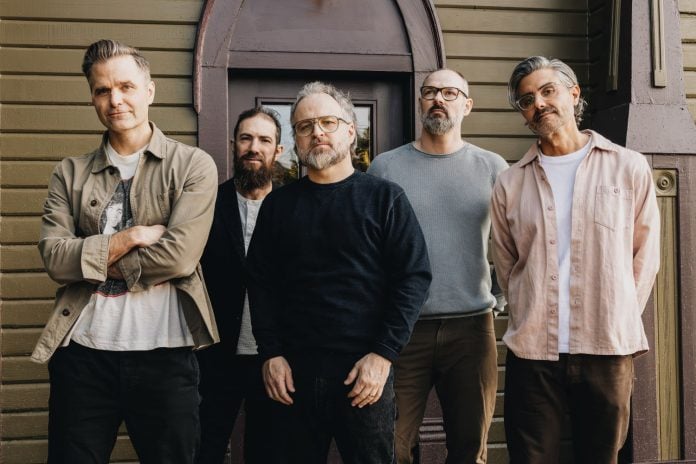
Historically, the lifecycle of a rock band is a short one. Even Bands that “Make it” often face innumerable challenges that can prevent them from continuing that success. However a band or musician defines success, it can prove difficult to sustain. For this reason and many others, it’s important to recognize true longevity when it happens. For many, the Story of Death Cab for Cutie Doesn’t require much rehashing-they are one of the most storied bands of the last three decades of indie rock.
From the Project’s beginnings in the Pacific Northwest in the late nineties to era defining records of the mid-aughts (Transatlanticism, Plans) to a string of successful albums in the decades that followed, Death Cab For Cutie has become a durable indie rock institution. With influence felt across wide swaths of music, and now with several generations of fans, Death Cab is one of the defining Indie Rock bands of the last thirty years. This month, the band released their eleventh album I Built You a Tower, a record that in different ways represents a fresh start, continuity and creative momentum.
Marking their first release on Major-Indie Anti- records after two decades on Atlantic and their second album working with producer John Congleton (St. Vincent, Alvvays, Courtney Barnett), I Built You a Tower is their strongest full-length in some time. Pairing evocative, reliably strong and evocative songwriting by Ben Gibbard with a musical palette that in many places feels rawer (and perhaps just a bit heavier) than many of its predecessors. This isn’t totally foreign musical territory for the band, who have long skillfully blended loud and soft, but the way they execute that on I built you a tower feels undeniably fresh, especially when leaning in to the raw side of the sound (“How Heavenly a State,” and “Punching the Flowers” in particular, rip very hard) The way longtime Drummer Jason McGerr tells it, it’s not a “return to roots” so to speak, but something of a fresh start.
Fans in Minneapolis will be among the first to hear I Built You a Tower live when Death Cab for Cutie Returns to the Armory on Friday. The New songs feel as if they were built for the live stage and will be strong additions to the already stacked Death Cab catalog and can’t-miss live show. In our Conversation with McGerr, he echoes this sentiment, expressing tremendous enthusiasm for the record and tour.
Below is an Interview with Death Cab for Cutie Drummer Jason McGerr. The Following has been edited for consistency.
Music in Minnesota: The new record was released on Anti- after a long run with Atlantic. I feel like with Death Cab For cutie, your story is intertwined with the label’s you’ve worked with in a lot of ways. What led you to signing with Anti-? They’ve put out a lot of great music over the years.
Jason McGerr: Our Atlantic records run was a great run, and it happened at a time that I think was the right time, on the heels of Transatlanticism and it’s success. Plans obviously did really well for us, and that team at Atlantic at the time was a fantastic team from the top down. We wouldn’t have done anything any different. But I think over time, given how much Atlantic has released, and the changing of guard and everybody from the radio department to publicity to marketing to the top of the label towards the very end, that was right around the time where we were starting to question if that was the best place for us. We were taking some time to think about making this record I Built you a Tower, and so we decided to make a change and look for another label. There wasn’t purpose like “Hey let’s go back to an indie label,” or to go “back to our roots.” It was more like “who can we find to work with that we see eye to eye with?” Maybe we’re closer in age, maybe there’s a good team on board that signed bands and artists that are friends of ours, where is that place? And Anti- Records kept coming up. We met with them a few times, and immediately, as they were leaving, the joke is Ben looked at Nick and said “so we’re signing with Anti- Records?” It was that immediate just from the conversation they’d had.
When you have a conversation with someone who runs a label, and they are as invested in your catalog as you are, and they’re asking you what you want the future to look like, and not just what you want the record to look like, that says a lot. So it’s as much of a testament to the people who run the label as the artists they’ve signed. It just felt like the proper move. We had already planned to fund and make this record ourselves after leaving Atlantic, so it wasn’t like we needed to shop this record. There wasn’t that sense at all. We knew what we wanted to do. I think when you show up to the table with a plan and product, if you will, and a legacy and a career, it makes it a lot easier for the label, but I Think they really respected that. Circling Back to Atlantic Records, we’re not the biggest fish on the label by any means, but when the majority of people you know and trust and can call at home on the weekend are not there any more, it’s weird to think about handing your album and career over to that. Again, back in 2005 Atlantic was perfect for us. I don’t know If we would have signed to Anti- records in 2005 that we would have had the some outcome. But you can go down the list of all the Bands whether it’s seminal artists like Nick Cave and Tom Waits, or artists like The Beths who are great friends of ours, Waxahatchee, there are so many amazing bands.
MIM: As a fan, that was what excited me about it. Even Setting Business aside, as a fan of the music, it was exciting to see you guys land there. And the Record is great.
JM: Thank you.
MIM: One area where you do have continuity is that this record was produced by John Congleton, who you had worked with on asphalt meadows. He’s also somebody that has history with so many great artists. How does the continuity in that role impact the process and shaping of the record?
JM: To Me,Comfort is the first easy word. Not to say comfort is always a good thing-sometimes discomfort yields better results- but I think that making Asphalt Meadows with John was sort of like preproduction in a sense. Working with somebody new, it was a day of rehearsal for the show. I built a Tower, being the show as a result, I feel like we’ve made a better record than we did last time. It was also ready to go before we set foot in the studio with John. So we spent a couple years writing and doing preproduction remotely, and then we got together a few times in the studio to see if they clicked in the room. Culminating at John’s Studio, animal rights, there was a list of songs we wanted to attack. Some of those were a few were songs that John had picked out that the band had almost forgotten about. Stone over water was one of those songs, and then john was like “how about stone over water” and raised his hand for that track. We had forgotten about it maybe close to a year prior to going into the studio.
When you get outside ears like that who you know and trust raising their hand like that, then you give it a shot. Then the whole record was pretty much done in three weeks. All the basics were live on the floor and vocals were done. It happened because a lot of parts were already figured out and discussed and because John Congleton is always looking for “is that the performance.” When I’m personally showing up with really strong ideas like “No, I think it should be this type of drum sound” and I present it to John, he’s like “cool.” It’s not like I had all the right answers, he just wasn’t super concerned precious or particular about a cymbal sound or snare sound or whatever. I feel like He trusted us and we trusted him. He did a really great job of capturing the moment and reading the room in terms of what everyone’s energy was. And Knowing when something wasn’t working, he’d say “no that’s not the right guitar” or “maybe grab another bass.” He would do that, but it would happen really fast. Typically, a song a day is what we would do, and most of the time over the course of the day we’d make sure the sound and performance was right, and moving at a pace that wasn’t so fast you weren’t paying to details. But again, he did a really good job keeping it going like a good coach should.
And then we had the record mixed by Carlos De La Garza, whose mixing we’d been fans of. It was nice to get another set of ears and a different perspective in terms of putting it all together. But the majority of the sounds that Carlos was able to work with were sounds that go back to the decisions in those three weeks with John. So what was presented to Carlos was ready to go. The recipe was already well considered.
I think even zooming out further, the concept of the album and it being more or less minimal and not overcooked, the mission statement of the album is that we all wanted to go into the studio being able to play and perform the parts that we would be playing on stage. We didn’t want to layer and do a bunch of extra overdubs and things in the studio that you can do because you have multitrack capabilities. We just wanted to sound like the band was going to sound like on stage. And That came from Going back even further, doing the anniversary tours, playing Transatlanticism from top to bottom, as well as Plans over the last three years.
MIM: The Minneapolis show is the first show of the big upcoming tour. Is there anything special to you about an opening night show in general? What are you most excited for with regards to this tour?
JM: Well it’s been four years since we’ve played new material in Minneapolis, and it’s been four years since we’ve toured a new album, and that feels really good, to go out and play new songs for people. We’ve played these songs twice, we played one festival, and one secret show where we played the album in entirety in L.A. The reaction and excitement both that I felt looking across the stage from my bandmates and the room full of people hearing a lot of the songs for the first time, was awesome. I feel like we really made something special. And Minneapolis, I don’t need to tell you the music history of Minneapolis. It has always felt like a fantastic town to play a show, whether at First Ave or elsewhere. Seeing all the music I’ve seen there, it’s one of the stops that feels really important, so being able to start there feels really good. I just cannot wait to play new material. These songs work really well live. I don’t think we’ve ever made a record where we can can choose to play every song without needing something to fill it out. All of these songs feel great live. It’s gonna be hard to choose from eleven records which songs to play (laughs). I can’t wait to get out and get these songs in front of people.


