



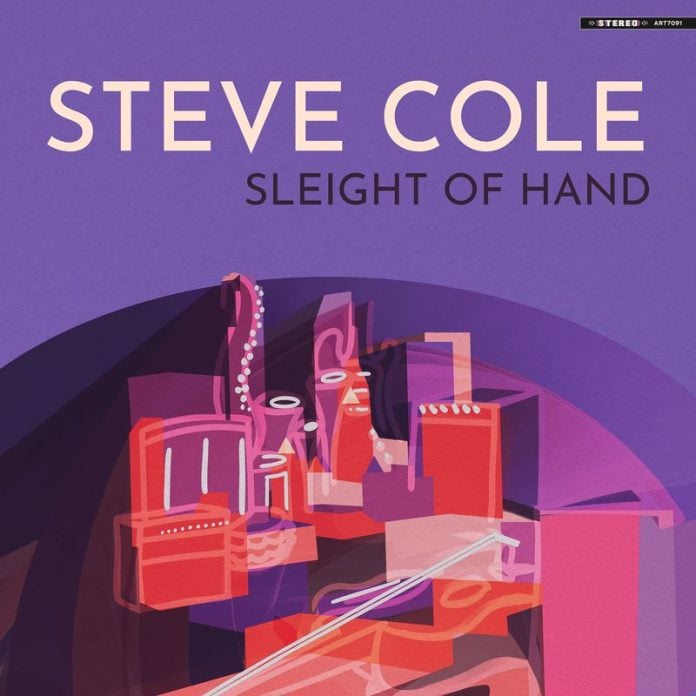
At Music in Minnesota, we strive to do a lot of things, chief among them covering music in and around Minnesota. Sometimes this means covering local artists, at other points this means covering musicians that come through the region. We truly have a special music scene here in Minnesota, with many top-tier venues of all sizes and countless inspiring artists across a wide variety of genres. On his latest project Sleight of Hand, Saxophonist Steve Cole draws inspiration from “Minneapolis Sound” era funk, as well as music that preceded and followed that era. The inspiration comes from a very real and genuine place for Cole, who spent his formative years in Chicago before relocating to the Twin Cities a little over a decade-and-a half ago.
On Sleight of Hand, released June 5th. Cole demonstrates a clear affinity for and keen understanding of the sounds that defined those eras, all filtered through his distinctive contemporary jazz lens. The Album represents a culmination of his decade-plus living in the area, and features a number fellow stewards of the sound, whose names should be very familiar to Funk Aficionados. Among them are legendary organ player (and Cole’s longtime friend) Ricky Peterson who make an especially memorable turn on the gospel-tinged album closer “Sunrise” and Vulfpeck guitarist Cory Wong, who brings his signature locked-in rhythm and funky fretwork to “Maceology.” The latter track, a tribute to the late sax great Maceo Parker-a longtime James Brown Bandleader and a frequent prince collaborator-is the most driving on the album, which explores a wide range of tempos and textures. Cole made his name in the smooth jazz world, and that influence is felt throughout the album as well, especially on some of the slower material (“Groove Ballad” is as the name describes). This aspect is one of several that should feel familiar to longtime Cole fans, as should the connection to longtime Cole Producer and collaborator David Mann, who returned to produce Sleight of Hand. While Sleight of Hand stylistically blends old and new, the performances are as strong as Cole fans have come to expect. Cole’s playing is dynamic throughout, helping bridge and bring these musical worlds and arrangements to life in a way few others could.
Below is an interview with Steve Cole. The following has been edited for consistency.
Music in Minnesota: What First Brought you to Minneapolis?
Steve Cole: What first brought me here was a girl (laughs). She’s now my wife so that was a good thing. I moved here from Chicago probably sixteen or seventeen years ago. That’s what inititially got me here. When I did get here I knew some musicians so it wasn’t a complete blind relocation. I knew Ricky Peterson, having worked with him on previous records. I did have a little bit of a toe into the scene, but I only knew a few people here.
MIM: It probably helped that you were established at that point. It’s interesting to make a pivot from a scene you’ve been entrenched in into another city and scene.
SC: It was lucky for me that the peterson’s and I were acquainted, because that’s a really difficult thing to do. I know a lot of people who have relocated from one place to another and found getting into the scene and getting to know people really difficult. I had lived in Chicago all of my life, and had a lot of longstanding musical relationships with different players, studios, producers, and writers, so it was a little bit of a tailwind, but it was still difficult. People who are already established kind of have their thing, and aren’t always looking to add new members. But It ended up working out great. To your point, I was fairly established in that the lion’s share of what I did was not local. What I can say is that fast forward to now, I am so glad that I am here because I’m working with and performing with some of the best musicians I’ve had to pleasure to do so with.
MIM: How did Minneapolis inform the sound of this record? I can hear some things as far as the funk, the groove. How did that sound, style, and set of influences play into making this album?
SC: Chicago, even though it’s just a few hundred miles away, has a different feel. It’s interesting how different cities have different feels. You play soul or funk music in London and It has a character of it’s own. You play in Chicago and it has a character of it’s own. Minneapolis certainly has it’s own sound. It was really interesting to come here and experience how musicians in this city naturally feel soul music and funk music. For me it was really cool because on one hand I had always admired it, but coming here and playing with these musicians who are really natural in that feel, I never really appreciated the subtleties and nuances of the way that Minneapolis musicians feel that groove. It was a little bit intimidating at first. I think Chicago is very steeped in more of a James Brown feel to funk and Minneapolis has more of Prince and music there even before Prince. It was getting used to that and starting to appreciate it. And then the kind of collage of influences coming from one set of influences to another set of influences and then you mix it all together. It’s really both of those influences that helped me find a unique approach in a cool way.
MIM: I want to ask about “Maceology.” You mentioned the James Brown school, Maceo is the James brown school and somebody who also has some Minneapolis connections. What inspired you on this record to pay tribute to Maceo?
SC: I think that for me, Maceo Parker is the ultimate feel player of all time. I so admire musicians who are able to speak volumes not neccesarily with a ton of notes and vocabulary but just by putting the right note in the exact right place in the exact right time. That to me is the pinnacle of playing and feeling this music. Maceo is the embodiment of that. I don’t care how many times I listen to Maceo Parker, there’s always going to be something that surprises me and there’s always going to be something that inspires me. It’s normally not a bunch of notes type virtuosity in the common sense of the term. It’s just that I would have never thought of putting those two notes together at that rhythm, at that point, and it’s brilliant. Maceo has always been one of the artists who I’ve always admired and have always been fascinated by. It felt like this tune would be a great way to just kind of nod to him for inspiring so many musicians, and for the role he’s played in my development as well.
MIM: It’s a great song. I do want to add, Cory’s part is great on that song. When you talk about the Funk feel and the Minneapolis feel, he’s sort of a modern embodiment of that.
SC: Absolutely, it’s super cool to have him as a featured guest on this tune. It was wonderful and very generous of him to do this. He’s another guy who every time I hear him I’m like “what is going on in your brain dude, where did come from” (laughs), but he’s in the same kind of category of very unique, very Minneapolis, but kind of a modern evolution of the Minneapolis sound. He’s got just an amazing feel. He’s super unique and definitely found his own voice. He also works harder than anybody I know.
MIM: “UK” is a song that has the big string and disco sound. Disco is another thread that runs through this album, and those strings are great. I’m curious about that song, and the title as well.
SC: It’s a meaningful title but also sort of a working title (laughs). In instrumental music, it’s really about the story and where it comes from. I’ve always been a huge fan of British bands like The Brand New Heavies, Jamiroquai and earlier Lisa Stansfield and that kind of thing. I’ve had the opportunity over many years to work with some phenomenal players in the U.K. and I go to London at least once a year. And again, cities have a feel, and these musicians have a very distinctive feel. I love the feel that lives in London, and I think a lot of it is the influences of those bands. So I always end up channeling that. This one was written shortly after I got back from playing in the U.K., so that was the working title as I was writing it, and I kept it. It’s very much inspired and influenced by the London bands and place.
MIM: The title track also has a bit of a disco feel, it starts lower key and then builds and has that great electronic feel at the beginning. Where did that feel come from?
SC: If I had the transcription up I could tell you (laughs), but a lot of it is just experimenting with different sounds or different arpeggiation, just trying to get something that is inspiring harmonically, sonically, and rhythmically. The guy I work with a lot, and have over the last twenty or so years is David Mann, and he’s just brilliant at that stuff. When we start talking about what we’re looking to do, and what kind of vibe are we feeling, A lot of times we’ll start with something like that, a texture, and see what we can do and go from there.
One of the big Challenges is that I don’t want to repeat myself. I don’t want to do the same thing over and over, that can get boring. And people expect that if you’re putting music out into the world that you’re gonna put your best foot forward. One of the things that I always try to do with the music that I write is making it accessible but not predictable. You can go in different directions, try different things, and really go off the beaten path a bit. When David and I were talking about and starting this record, we kind of gave it a little bit of a term-taking a bit of a left when you were expecting to take a right but youre still in the same neighborhood-we’re gonna call it Sleight of Hand. Every once in a while a surprise, something creative that isn’t expected. This tune is kind of the embodiment of some of those things we always try to do to keep life interesting.


