



Of all the many storied American music cities, few rival New Orleans. With an incredibly rich musical history that spans centuries and contributions across nearly every major genre, New Orleans occupies a unique space in the American and global musical landscape, a space that remains relevant to this day. It’s a singular city that has produced a lot of singular music over the years. Some of this great music crossed over into the mainstream, and some remains relatively obscure, but the best music from New Orleans always sounds like the city that birthed it.
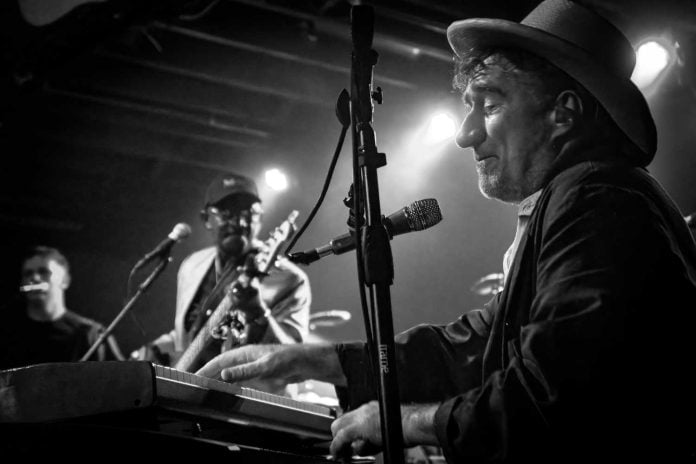
Few musicians in 2026 tap into the history and traditions of New Orleans music like Jon Cleary. An incredibly skilled piano player, Cleary draws heavily from New Orleans Rhythm and Blues. There’s a long tradition of great New Orleans piano players, from Jelly Roll Morton to Fats Domino to Dr. John (not to mention so many more), and Cleary fits squarely into that lineage. Having now been playing the music for a long while (the British-born Cleary first moved to New Orleans over forty years ago), Cleary is both an encyclopedia of New Orleans Rhythm and Blues and a de facto ambassador for some of the best music the city has produced.
A brilliant player, skilled songwriter and a soulful vocalist, a Cleary show is a must-see no matter the context. His solo shows, which he’s occasionally played at The Dakota, are intimate and fascinating explorations of his own music and New Orleans cuts you won’t hear anywhere else. Fans of that side of Cleary should be excited by an upcoming solo release recorded at Royal Albert Hall.
While the Solo shows and recordings are great, Cleary’s work takes a different shape when he plays with his killer band, The Absolute Monster Gentlemen. With the Gentlemen, Cleary’s sound gets bigger and funkier, tapping into the energy and rhythms of the city’s funkiest sounds (Their live rendition of The Meters’ “Just Kissed My Baby” is as funky as anything you will find). They’re one of the tightest funk bands you’ll hear, and catching them live is always a treat.
On Thursday night, Jon Cleary and the Absolute Monster Gentlemen will kick off a strong State Fair Grandstand slate when they open for legendary singer-songwriter Bonnie Raitt. Cleary Played in Raitt’s band for a number of years, a collaboration that now goes back multiple decades. It’s one of the best shows on the grandstand lineup this year, and fans of both have much to look to forward to. In our Interview with Cleary, which you can find below, we discussed the show, his long connection to Bonnie Raitt, and his fascinating beginnings as a working musician in New Orleans.
Below Is an Interview with Jon Cleary. The Following has been edited for Consistency.
Music In Minnesota: This will be a Monster Gentlemen show. I know in recent years you’ve played here and elsewhere in both solo and full band setups. I’m curious what you enjoy most about playing solo and with the full band.
Jon Cleary: They’re very different in many respects. With the full band show we’re gonna play arrangements-we’re not really a blues band-the New Orleans stuff is more sophisticated with vocal arrangements that can be quite complicated. It’s fun because the musicians are so good that you can take delight in the craft.
The Solo thing is a different beast in that it’s just me, so I can have complete free reign to go off on a tangent if I choose to . I can deviate from the plan at any given point. I mean we can do some of that with the band, but it has to be done within the framework of the arrangement. No two gigs are ever identical, there are moments in each gig and each song where I can call out a change from the plan. The role of the piano is different with the group because the bass is already taken care of by the bass guitar, so you play differently. If I’m playing a solo gig I’m usually doing everything, playing piano as an orchestra really. You have to imply everything a band would do, playing percussion, the bass line, imply all the movements of the song with the chord inversions that you use. It’s much more so the flying by the seat of your pants improvisation really in a solo context. So, they’re two very different things.
MIM: Another thing that will be different about this gig compared to some of your recent gigs here is that the Grandstand is a very different vibe and setup than a club or a smaller stage. You’ve played all sorts of gigs-what do you get out of playing at a big outdoor gig like this?
JC: Well really what we do-and every member of the band would have an interesting answer to this-because we do this all the time and often don’t know what a venue is like until we arrive at soundcheck, we play for each other on the stage. It’s really about the bond between the musicians on the stage for that time that we’re actually performing. So, I just invite the musicians and they have a high bar to satisfy. I find if we’re satisfying each other on the stage, then it’s a given that the audience is taken care of. Our Bar is much higher than the audience’s. So, it doesn’t matter if we’re playing a small room or a big open-air stage where you can’t see the audience because they’re miles away, the important thing for us is to do our thing. I know if that’s happening everyone will be happy. If you’re in a small club of course, where you can see the whites of their eyes as it were, and the audience is really focused on what you’re doing, it’s as if they’re beaming an electrical force field at you with their energy, that’s very exhilarating. Sometimes on the large outdoor stage, the audience can be quite a long way from you and so you can’t rely on that. The first thing is to make sure the band is satisfied, and all on the same page. Then as a unit, you can transmit on the wavelength a signal that is strong enough to reach the back of an auditorium or the back of a field or whatever the situation is that you’re playing.
MIM: You’re opening for Bonnie at this show. I know you guys go way back-you played in her band, you’ve collaborated and shared a lot of bills. On that note, what has it been like working and collaborating with her? How have you seen her evolve over the years?
JC: Well first and foremost, when I was a teenager in England, I used to carry a bag of records to parties because I wanted to bring my own music. One of the records in there was a Bonnie Raitt album that had a version of “I Know” by Barbara George. I loved that. So, I knew she was hip to that style of New Orleans funk that matched my personal taste. So I was a fan of hers long before I ever met her. We’ve been friends for a long time now, over twenty years, more like thirty I’m guessing. She sings from the heart and from the soul, and that’s the most important thing. When she sings it’s the real deal-soul music, with a lot of heart and a lot of passion. She delivers it every night, and I watched her do it night in and night out. A consummate professional. It’s very heartfelt. In New Orleans, this is a place where heartfelt music is a premium commodity. Bonnie Raitt especially appreciates that.
MIM: I want to hit at a couple things you mentioned. You mentioned back when you were in England growing up you had her records and that preference for New Orleans music. I think for many, you are sort of an ambassador for a lot of that great music. I’m curious how you made that initial connection to that music and what brought you there?
JC: Yeah definitely, I came here for the music. I grew up in a family with a lot of people who played musical instruments. They loved music and had record collections. My Grandparents played music. My granddad was a singer and a dancer. My maternal grandmother was a singer in the 1940’s. My dad played in bands in the 50’s with a whole repertoire that included New Orleans Jazz and Leadbelly. I had three uncles who played in bands-one was professional, one was semi-professional, and one was amateur-all great players. The whole family did some really cool stuff. There was some Irish music, gospel quartet stuff, Caribbean music, blues, R&B, funk, soul. So I had a very rich education just in the family get togethers. Everybody would play and sing all night long. That wasn’t very typical of anybody else I knew in England. It was more like what you hear about the tradition here in New Orleans, where you learn music in the family home rather than in a school.
The New Orleans thing really came from my mom, she really loved New Orleans Jazz and her younger brother, my uncle, came to New Orleans in the very early 1970’s and when he came back he had a suitcase of 45’s. I got to hear stories about Professor Longhair and hear all the New Orleans R&B records. Those were records you couldn’t find in England. He hipped me to Clifton Chenier and Snooks Eaglin and it was great. I got to hear all that music while my friends were watching Top of The Pops and listening to glam rock. I was getting a completely different type of information.
They all taught my how to play. I picked up guitaras soon as I could, because all of the men in the family played guitar. So I had great teachers, and New Orleans was a really large part of it. It seemed so glamorous that I decided I’d go and see for myself what it was like. And so some time thereafter I got on a plane and landed on my feet.
MIM: I can relate as someone who came from a musical family. It certainly comes out in the diversity and the depth of the music that you play that you have such a rich background in so many styles of music. This may also tie back to your family and some of those experiences you mentioned, one of my favorite aspects of what you do is your vocal style. When did you start singing?
JC: I loved singing when I was little, and then as a boy your voice all of a sudden changes. And as a singer, if you’re discerning, you find music that moves you and music that doesn’t and search out whatever you can. The singers that I mostly liked to hear were Black American Singers and so I’d make a terrible wailing caterwauling noise at the age of thirteen trying to sound like Little Richard, screaming like a lunatic. My dad would storm in to the room immediately and tell me I would damage my voice (laughs).But I liked Bobby Womack, Johnny Taylor, Little Richard, Sam Cooke, that vocal style. I also liked Lowell George, Robert Palmer, Frankie Miller. I loved Frankie Miller’s voice and one of my uncles was in Frankie Miller’s band at the time and he cut “Brickyard Blues,” which was an Allen Toussaint song. I always tried to emulate the singers I liked and I suppose if you do that every day for years and years eventually that’s how you build your style-the inflections, the dynamics and the phrasing. That all comes out of gospel music really. Growing up in a sleepy medieval village in the countryside of England, there wasn’t a great deal to draw from other than records, so I just listened to records. But my uncles were great singers, so I’d try and emulate them as well. So, you emulate people until you basically end up an amalgam of all these different things that goes through your unique set of filters and comes out hopefully sounding like you.
MIM: When you got to New Orleans and played there in those early days, who of your heroes did you get to meet and play with?
JC: When I got here, I was seventeen or eighteen years old. I spent two years because my Visa ran out. In those two years I was really just listening and shedding. I wasn’t very good at muscling my way on stage or asking if I could sit in. I didn’t think I was ready. But I played for hours every day, and went out and saw a lot of James Booker, I saw all of the visiting acts that were coming in and all of the local acts that were playing around town. Earl King, Ernie K-Doe. The Neville Brothers of course were the big band at the time. I was just like a sponge soaking it all in. I went to England and my uncles were doing gigs in the pub circuit in London. All my friends had gone to university, and my university was New Orleans, so now was an opportunity to try it out. Within Weeks I was playing with a couple of bands. I put my own band together. I did that for about a year and a half, and learned lots of the nuts and bolts and practical aspects of the business-hustling gigs, getting paid, hiring musicians, getting ads in the paper-real mundane stuff. After doing that for a year and a half, I was ready to go back to New Orleans. When I landed back in New Orleans, I went to work straight away, which led to me solo gigs and getting hired to play with Earl King and Snooks Eaglin, Ernie K-Doe, George Porter and all of the Cats. I had learned how to play New Orleans R&B piano, and at that time there were very few people in New Orleans who played that old style. The young cats coming up wanted to play jazz-funk and play electric pianos or B3 Organs, but the old guys wanted a young person who was affordable that could play their old music and I fit the Bill. And then later I got to play with people like Taj Mahal and Bonnie and Dr. John, so one thing led to another really.
MIM: I want to ask quickly, you mentioned Seeing James Booker. What was that like then? He was such a wild and brilliant musician.
Jon: At the time, it was unremarkable. He wasn’t very famous or well known, even in New Orleans. There were a handful of people who were Devotees of James Booker. Amongst the older generations of Black Musicians who had a lot of respect because they remembered him from the heyday of sixties and seventies-He was acknowledged and admired by his peers. But he played gigs at the Maple Leaf-my local bar-he played every Tuesday night. He was one of the locals, it wasn’t a big deal, I saw him all the time. So I saw him over and over again. The first piano gig I actually did in New Orleans was covering for him one night when he didn’t show up. The manager of the bar asked me to get up and play so that the people who had already bought their tickets wouldn’t ask for their money back. He died when I went back to England, and then the legend of James Booker started to develop. He’s much more well known now than he ever was when he was alive. It’s tragic that he didn’t get the respect when he was alive. He’d play at the Maple Leaf, and sometimes there would be like sixteen people in there that paid the five dollars or whatever it was to come see him play. Some nights they had more people in there. There was music every night, and he was just the Tuesday night guy. Now that he’s a legend, he’s had these records come out and there loads and loads of people who are James Booker experts. But that wasn’t the case when he was alive and playing. It was sad really, because he was really good, he was amazing. He wasn’t always amazing though, he was a bad junkie and an alcoholic, so sometimes if he was too loaded he couldn’t play all that great. But when he was really on, he would be startling. He was a big influence on me.
MIM: I want to flash forward back to now. You are somebody who is so associated with New Orleans and that music, having lived there for a long time. What has changed the most from then to now in the city and the scene?
JC: I’ve been here for forty years so everything changes hugely, the world changes. As far as differences that are particular to New Orleans, I think when I first came here, oil was a big deal. New Orleans has been in the doldrums in the sixties and seventies. There had been White Flight in the civil rights era, and all of a sudden oil happened in the late seventies and they started drilling offshore. Suddenly, it was a cash economy. For a brief second, New Orleans was kind of a boomtown. I was lucky that I landed at that point because it was very easy to get a job. Everybody had cash, everybody was getting their houses fixed up. When that collapsed, which it did very dramatically, they decided to promote the city as a tourist destination. They spent a lot of money looking at how they could monetize the charms of New Orleans and south Louisiana. So that was a process that kicked in quite quickly. That changed the nature of New Orleans, I think. There was no tourist resort when I first landed here. International tourists didn’t come to New Orleans, they went to New York San Francisco, and Florida. So, it’s charms have been commercialized and that has changed the nature of the city I suppose, to a degree.
It was very remote. It felt like it was cut off, like New Orleans was a tropical Island that got wedged onto the United States by Accident. Now we’re all connected. The Younger people growing up are all part of the big wide world, where perhaps in 1981 people coming up were New Orleanians first and foremost. The culture has changed, I would say some of it has been eroded a little bit. Some of that, like the Mardi Gras Indians and the second line parades have changed in the nature because they have been sort of exploited. They’ve gone from being well kept local secrets to the stuff that’s advertised on the internet as attractions that you come see when you come to New Orleans.
The Music Business has changed, rap happened (laughs) that wasn’t there when I came to New Orleans. The Older Generation are all gone. We just lost James Rivers, one of the last from the R&B generation, he died a couple of weeks ago at the age of 90. The Music has changed, but everything changes, everything does change. It’s still a fantastic town. The people are great; the food is great. it evolves. When you live here it’s a slow process, so you don’t really see it. So perhaps I’m not very well qualified to answer that question (laughs). If you had someone who had been here three times over the last thirty years they might have three different takes. Of course, the big change was Hurricane Katrina. A lot of people here tend to think in recent history about before Katrina and Post-Katrina. That changed a lot of stuff here.


